PAGES

Showing posts with label Pittsburghese. Show all posts

Tuesday, March 31, 2020

Example of a Multi-Purpose Survey


In Monday's Zoom, we talked about updating a survey, the Western Pennsylvania Local Speech Survey, I did in this class two years ago with new questions. Here's a heatmap we were able to generate from that survey, looking at the geographical distribution of the Pittsburghese word jumbo (for 'balogna'):


Here is a link to the questionnaire for that survey:
Anyway, look it over and try to think of new questions we might want to explore this time around. Post your suggestions in the comment section...

Friday, March 27, 2020

Linguistic "Groupyness"


            La petite anglophone avec le nom francophone, or how to survive a ...


             At the end of Chapter 5, the authors use Pittsburghese as an example for linguistic identity. In a large paragraph, they list several words and pronunciations that are associated with people who live in Pittsburgh. This list includes the usual terms we hear: nebby, slippy, yinz. After all that, however, we learn that outside of possibly the pronunciation of “dahntahn” and the use of “gumband,” “none of these items is unique to Pittsburgh”; instead, the idea of Pittsburghese is more about identity and the “people’s pride in being residents of Pittsburgh” (154). This surprised me (although it probably shouldn’t have). I didn’t realize that almost all of these linguistic differences were not unique to Pittsburgh, and that the idea of having a “Pittsburghese” was about the sense of having a “linguistic homeland.”
            This all reminded me of the linguistic biography I did about the different languages in China. My aunt explained to me that small and distinct linguistic communities are what make someone feel connected and part of a group. The idea of having an insider language that only a certain group understands is not only useful, but unifying. She mentioned that Mandarin, although it is the national language and gives people a common ground, does not unite the Chinese people in the same way that local languages do. This feeling of “groupyness,” found in smaller communities, is strong. Perhaps the idea of identity related to Pittsburghese is similar in the way it unites the people who live there and speak accordingly. But what’s the difference? Does the person in China, who speaks several distinct languages, have a deeper connection with those who are from the insider language than people who have only a dialectal difference? Is there something to be said for the ability to move in-and-out of multiple languages rather than switching between dialects? Also, do dialects lead to distinct languages if groups of people are separated for enough time?

Other questions I had from this chapter…

-       -     Are there any big differences in grammar across the linguistic regions of the US? Our book talks about small differences that apply to just one phrase, but are there overarching and applicable grammar rules that are distinct to a region?

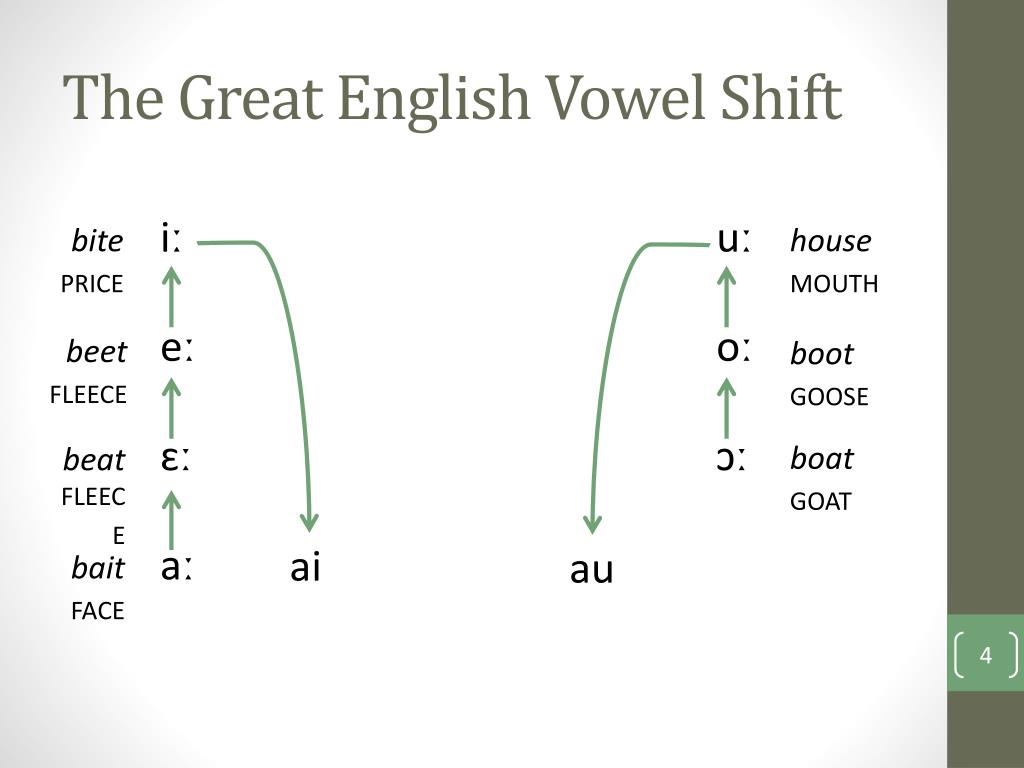
-       -     The different vowel shifts are cool (pgs. 137-140)! Am I thinking correctly in imagining them to become like the GVS we learned about in Intro. to Linguistics? Will the vowels move enough to be completely new words so that the dialects are extremely different in each region (so different that they cannot be understood by outsiders)?

PPT - Northern dialect evidence for the chronology of the Great ...

Friday, March 20, 2020

Ideas to Be Thinking About

So what are we going to do with ourselves the rest of the semester, besides read some stuff and talk about it? I have always, with this class, made a point of doing a class project—interviewing people (check: did that), collecting data about some aspect of dialect, testing a theory—and I am loath to let that go, even in our diminished sequesterment.*

    
     * New word. You saw it here first, folks!

At our first Zoom session (which turned out to be fun, I thought), we talked about a few ideas for potential surveys (online, obviously, given the present circumstances). As I recall, these were as follows:

Pittsburghese — There are reports that Pittsburghese is experiencing considerable dialect swamping, and is beginning to fade in the speech of younger generations. Conversely, to what extent are incoming outsiders picking up aspects of Pittsburghese in their own speech as tokens of acculturation? Can we figure out a way to explore these questions?

Dialect & Gender — There are all kinds of ways in which our gender influences our speech. Reading up and focusing on some of those patterns, can we devise some kind of survey that would show this in action?

Language of Social Media — There is a lot of research on this of late, but I don't know what's in it. People would have to read into it and figure out how to do something with it. Could be very interesting...

Loss of Rural Vocabulary — A whole lexicon of older mostly rural expressions of Western Pennsylvania seem to be disappearing. The last time I taught this class we looked into some of this; there is a lot more to explore...


Personally, I think they all sound like fantastic research avenues. So why don't yinz-all think about them and decide which ones you think sound interesting to you, that we might like to work on as a class in the time we have left. Maybe we could even break into groups to tackle more than one of them...

Thoughts, anyone? (You can blog on these ideas yourselves, as well...)